
How to Read Water: The Complete Beginner Guide to Currents, Conditions, and River Features
Understanding water is the single most important skill a paddler can develop. Every lake, river, and stretch of ocean is speaking to you — if you know how to listen. The difference between a confident paddler and a novice isn’t just technique; it’s the ability to read the water and predict what’s ahead.
This guide covers everything you need to start reading water on your very first trip. From basic flow patterns to advanced river features, you’ll learn to see what experienced paddlers have been seeing all along.
Why Reading Water Matters
Before we dive into the features, let’s understand why this matters. Reading water is about predicting the future. It tells you where the current is strongest, where hazards hide, where calm water offers rest, and what’s happening below the surface — all before you arrive. It’s your early warning system, your route planner, and your safety net rolled into one.
Paddlers who can read water navigate more efficiently, spend less energy, avoid hazards naturally, and have more fun because they’re reacting to the water proactively instead of reactively.
Reading Flow: Where Is the Water Going?
The most fundamental skill in reading water is understanding flow direction. Water always moves from high to low, following the path of least resistance. Here’s what to look for:
- Current lines are visible streaks on the water surface where flow is fastest. They often carry floating debris, foam, or lighter-colored water downstream. These are your guide to the river’s fastest sections.
- Eddies form behind solid objects like rocks or bridge pilings. Water flows upstream in the eddy — opposite to the main current. They’re often calmer and make great rest spots for catching your breath mid-rapid.
- Eddy lines are the visible seam between the fast current and the calmer eddy. Marked by a line of debris or foam, they can be turbulent to paddle across and are where beginners most commonly flip.
- Pillow water — a hump of smooth water upstream of an obstruction where the current is piling up against the obstacle. It’s a telltale sign of something below the surface.
Reading Features: What the Surface Tells You
Beyond general flow direction, specific water features tell you exactly what’s happening beneath the surface.
- Standing waves are formed when water moving downstream hits a submerged obstruction and rebounds back up. They look like waves that aren’t moving downstream — hence the name. Often rideable and sometimes signs of turbulence below.
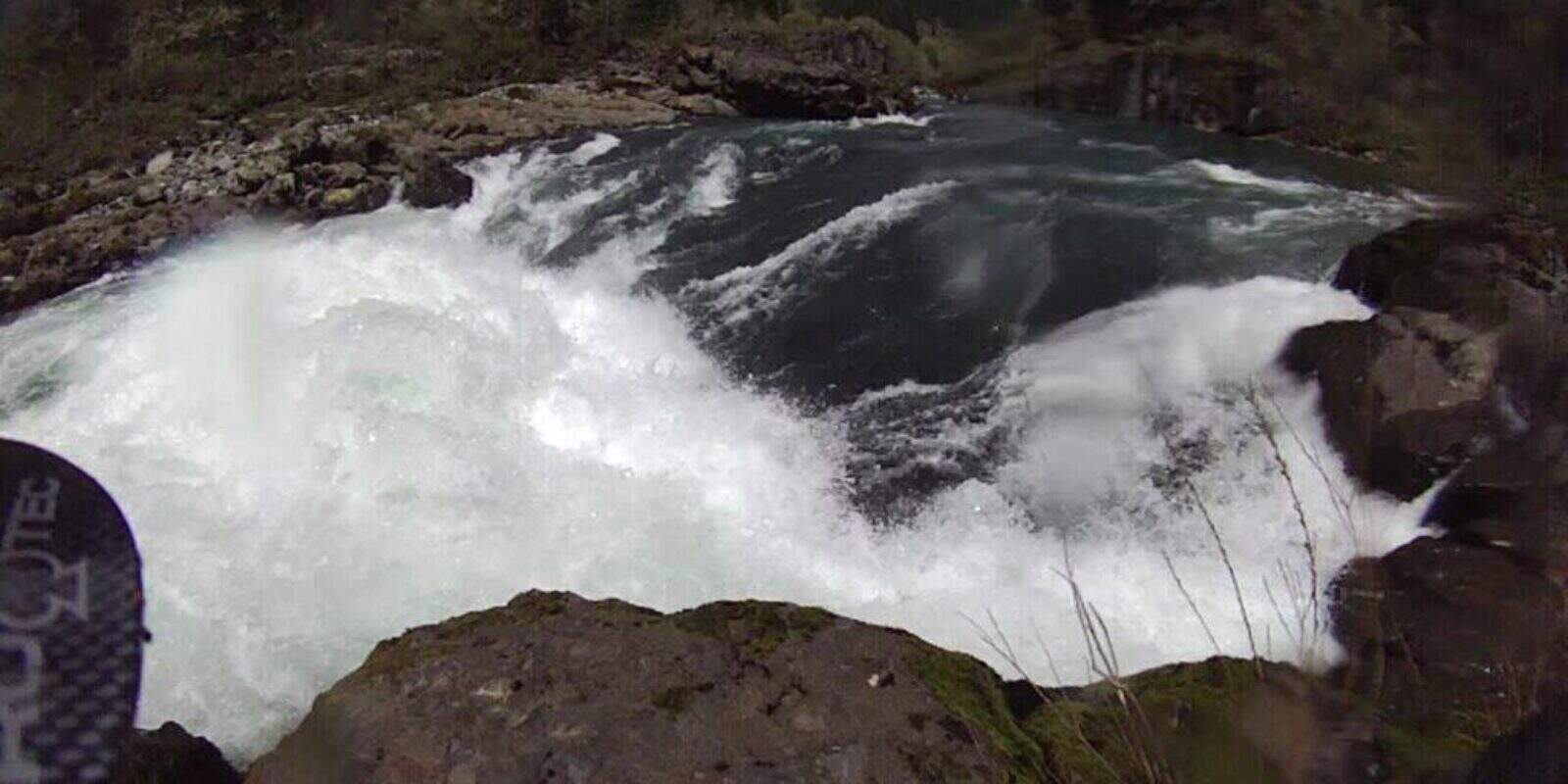
- Holes (or hydraulics) form when water pours over a drop and creates a recirculating current. Marked by a smooth, flat-looking face followed by turbulent whitewater. Small holes are playful; large ones can trap boats. The size of the hole relative to the river width tells you how dangerous it is.
- Strainers are submerged obstacles — fallen trees, submerged logs, or debris — that allow water to flow through but block boats and people. Look for a line of foam or debris caught on something below the surface. Avoid at all costs — they are among the most dangerous river hazards.
- Waves — the undulating surface of moving water. Understanding wave height, frequency, and direction tells you about wind, fetch, and current.
Color Coding: Depth at a Glance
Water color is your fastest indicator of depth and composition:
- Dark green or blue — deep water, safe to paddle over.
- Light green or transparent — shallow water where you can see the bottom. Be cautious in rocky areas.
- Muddy brown — high sediment content, usually from recent rain or runoff. Visibility is limited.
- White or yellowish — foam or air bubbles from turbulence or pollution. Generally safe, but a patch of sudden, dense white foam can indicate a hydraulic or whirlpool.
Reading Rivers: Class and Gradient
River difficulty is rated on the International Scale of River Difficulty (Class I through VI). Understanding these classes helps you choose appropriate rivers for your skill level:
- Class I: Fast-moving water with small waves. Minimal obstacles. Ideal for complete beginners.
- Class II: Straightforward rapids with clear channels. Moderate maneuvering required. Good for experienced beginners.
- Class III: Technical rapids with moderate waves and confusion. Requires solid technique and the ability to scout hazards quickly.
- Class IV: Intense and powerful rapids. Requires expert-level navigation and rescue readiness.
- Class V-VI: Extreme whitewater. Not appropriate for recreational kayakers without professional training.
A good rule: never paddle water above your ability level, and always scout unfamiliar rapids on foot before committing.
Reading Ocean Water
Ocean paddling adds additional layers of complexity: tides, surf zones, and open-water swells. The basics of reading ocean water for paddlers:
- Tidal currents — look for indicators of strong tidal flow: standing waves in narrow channels, whirlpools near rocks, and patches of dramatically different water color or height.
- Surf zones — the zone where waves break against the shore. Understanding where and when waves break is critical for launching and landing safely.
- Open swells — long, rolling waves that don’t break. They indicate wind direction and can be used to maintain course with careful paddling.
- Rip currents — narrow, fast-flowing channels of water pulling away from shore. Often visible as a darker patch between breaking waves. Strong paddlers can use them strategically; beginners should avoid them entirely.
Practical Exercises for Day One
- Spend 10-15 minutes watching water from shore before you launch.
- Throw a stick in upstream and track where it goes.
- Look for dark water (deep) vs. light green water (shallow).
- Watch how debris catches on rocks — that’s where eddies form.
- Try to paddle into and out of an eddy. Feel the current difference.
- Paddle against a current for a few minutes, then rest in an eddy. Notice the energy savings.
Reading water is a skill that deepens over years. But the basics — understanding flow, recognizing features, and knowing your limits — will serve you well from your very first paddling trip.